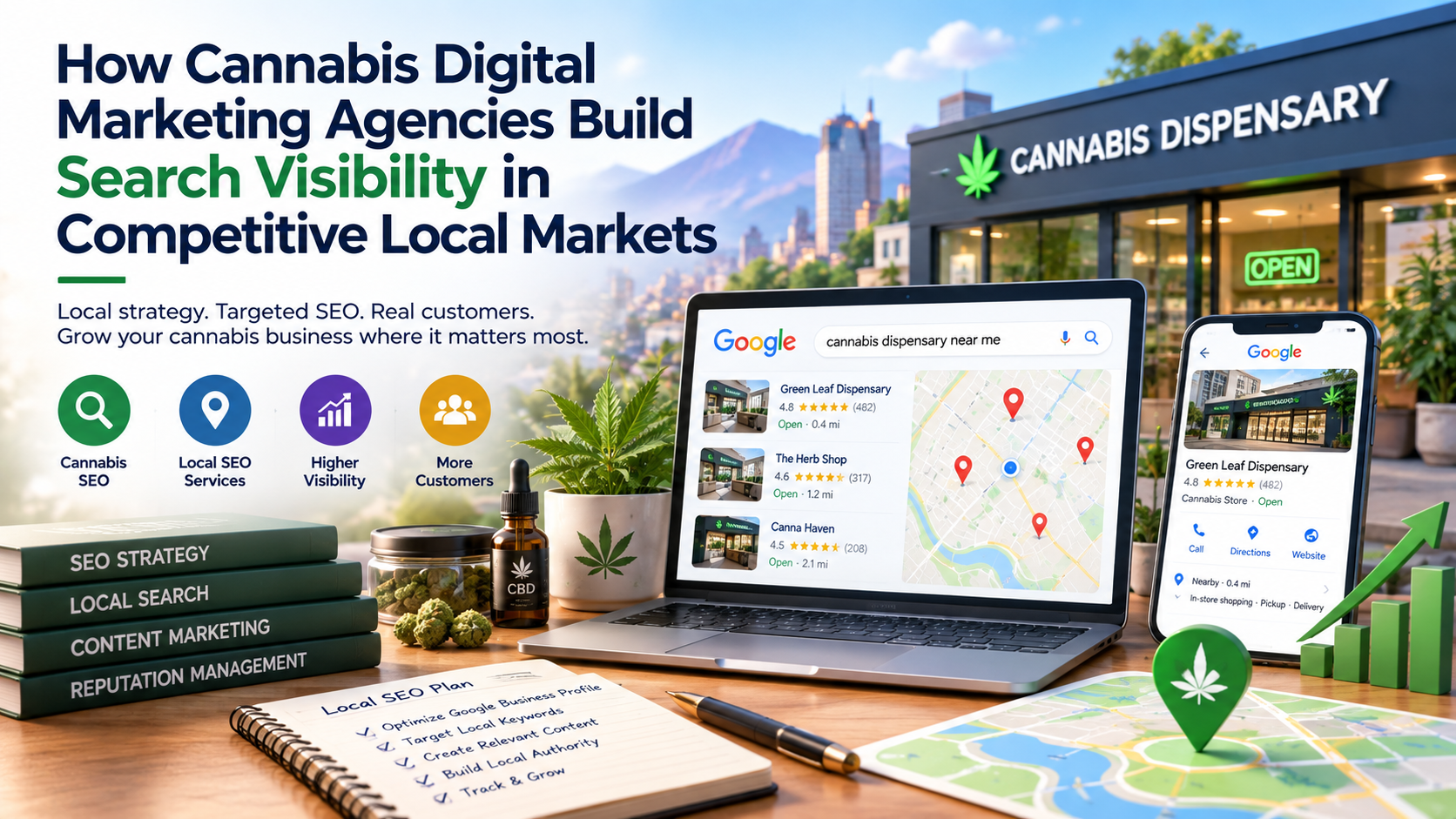
Cannabis and CBD businesses operating in competitive local markets face a difficult search environment. Customers may compare dispensaries, product brands, delivery options, retailers, and educational resources before deciding where to buy or which business to trust.
At the same time, cannabis-related businesses cannot always approach digital marketing in the same way as conventional retailers. Advertising availability, platform policies, local regulations, product restrictions, and differences between medical and recreational markets can all affect how a business builds online visibility.
This is why local search strategy has become an important part of cannabis digital marketing.
Rather than trying to rank for broad terms such as “cannabis” or “CBD,” businesses need to understand what people search for, where they search, what information they need, and how local competitors are capturing that demand.
Here is how specialized cannabis marketing teams approach that challenge.
1. Start With Local Search Intent
A cannabis business may serve customers within a specific city, neighborhood, or delivery area. That makes geographic intent particularly important.
Searches such as:
- Cannabis dispensary near me
- Cannabis dispensary in [city]
- CBD store near me
- Medical cannabis dispensary [location]
- Cannabis delivery [location]
- CBD products [city]
- Recreational dispensary [location]
can indicate much stronger local intent than broad informational searches.
A successful strategy begins by separating keywords according to intent.
For example, “what is CBD oil?” is primarily informational, while “CBD store near me” indicates a user who may already be looking for a local business.
Cannabis digital marketing agencies can use this distinction to prioritize pages and content around searches that are more relevant to the company’s actual market.
2. Analyze the Local Competitive Landscape
Ranking in a competitive cannabis market requires more than identifying keywords.
Businesses should first understand who already owns the search results.
A local competitor analysis can examine:
- Which businesses appear in local results
- Which pages rank for important keywords
- Google Business Profile visibility
- Review volume and quality
- Location relevance
- Website structure
- Service and product pages
- Local citations
- Backlink profiles
- Content depth
- Search features appearing for important queries
This analysis helps identify where competitors have established authority and where gaps exist.
For example, several dispensaries may have strong homepage rankings but weak pages targeting specific product categories or neighborhoods. That could reveal an opportunity to build more useful, intent-focused content.
3. Build Dedicated Pages Around Local Demand
One common mistake is trying to make a single homepage rank for every cannabis-related search.
A better approach is to organize the website around distinct search intents.
Depending on the business model, this could include pages for:
- Dispensary services
- Cannabis delivery
- CBD products
- Specific product categories
- Medical cannabis information
- Recreational cannabis information
- Individual locations
- Service areas
- Frequently searched product questions
Each page should have a clear purpose.
For example, a location page should explain the actual location, products or services available there, operating information, directions, and other useful details rather than simply repeating the same content used on another city page.
This creates a stronger relationship between the search query, the page, and the local business.
4. Strengthen the Google Business Profile
For eligible local businesses, the Google Business Profile can be an important part of local search visibility.
Businesses should make sure their profile information is accurate and consistent with the real-world business.
Important information includes:
- Business name
- Address or service-area information
- Phone number
- Website
- Business category
- Operating hours
- Photos
- Customer reviews
- Available business information and attributes
Cannabis businesses also need to pay attention to applicable platform policies and local requirements because eligibility and visibility can vary by business type and location.
The goal is not simply to fill out every available field. The profile should accurately represent the business and provide useful information to local searchers.
5. Develop Cannabis-Specific Content
Generic SEO content rarely differentiates a cannabis business.
People researching cannabis and CBD products often have detailed questions before making a purchasing decision.
They may want to understand:
- Product differences
- Cannabinoid types
- Product formats
- Usage considerations
- Storage
- Product labeling
- Local purchasing requirements
- Differences between product categories
- Questions to ask before purchasing
Educational content can help a business appear earlier in the customer’s research process.
For example, a CBD retailer could publish an article explaining the differences between CBD oil, capsules, gummies, and topical products. The article can then connect relevant readers to appropriate product or category pages.
The important point is to provide genuinely useful information rather than creating articles simply to insert keywords.
6. Use a CBD-Specific SEO Strategy
CBD businesses have their own search challenges because product categories, regulations, platform policies, and customer expectations can differ from those of conventional ecommerce businesses.
A specialized cbd seo agency may therefore focus on several areas simultaneously:
Search intent: Identifying whether users are researching products, comparing options, looking for a local retailer, or ready to purchase.
Product architecture: Organizing product and category pages so search engines and users can understand the relationship between products.
Content quality: Creating educational resources that answer real customer questions.
Technical SEO: Improving crawling, indexing, site speed, structured data, internal linking, and ecommerce architecture.
Local visibility: Building location relevance for businesses with physical stores or eligible local operations.
The strategy should reflect the actual business model rather than treating every CBD website like a standard ecommerce store.
7. Turn Reviews Into Local Trust Signals
Search visibility and customer trust are closely connected.
When customers compare local cannabis businesses, reviews can influence which businesses they investigate further.
Businesses should develop a legitimate process for requesting reviews from customers and responding professionally to feedback.
Reviews can also provide insight into customer expectations.
For example, recurring comments may reveal that customers value:
- Product knowledge
- Staff experience
- Store convenience
- Product selection
- Delivery experience
- Customer service
- Ease of ordering
These insights can inform website copy, FAQs, service descriptions, and broader marketing strategy.
Businesses should avoid fake reviews, incentivized manipulation, or misleading claims. Long-term local visibility depends on maintaining accurate business information and genuine customer experiences.
8. Build Relevant Local Authority
Local SEO isn’t limited to optimizing a website and business profile.
A business can also build legitimate visibility through relevant third-party references.
Potential sources may include:
- Local business directories
- Industry associations
- Local publications
- Community organizations
- Cannabis industry publications
- Local event websites
- Relevant business partnerships
The objective should be relevance rather than volume.
Acquiring hundreds of low-quality directory links does not create the same value as earning a few legitimate mentions from relevant local or industry sources.
This is where local seo services can become part of a broader search strategy rather than functioning as an isolated tactic.
9. Optimize for the Complete Customer Journey
A cannabis business should not measure SEO solely by rankings.
Consider a customer searching for a dispensary.
Their journey might look like:
Search → Local results → Website → Product information → Reviews → Location details → Contact/order → Purchase
If the website ranks well but fails to provide product information, operating details, clear navigation, or an obvious next step, the search visibility may not translate into business results.
SEO therefore needs to connect with conversion optimization.
Important landing pages should answer basic questions quickly:
- What does the business offer?
- Where is it located?
- Who does it serve?
- What products or services are available?
- Why should customers consider the business?
- How can customers take the next step?
10. Measure Visibility by Business-Relevant Metrics
A cannabis SEO campaign should use more than keyword rankings to evaluate performance.
Useful measurements can include:
- Organic traffic
- Local search visibility
- Google Business Profile interactions
- Website engagement
- Phone calls
- Direction requests
- Qualified inquiries
- Product-page traffic
- Conversion rates
- Non-branded search growth
- Performance by location
Tracking these metrics makes it easier to determine whether increased search visibility is reaching the right audience.
For example, gaining traffic from unrelated informational keywords may look impressive in an SEO report but provide little commercial value.
A smaller increase in local searches from customers looking for a nearby dispensary or CBD retailer could be considerably more relevant to the business.
Conclusion
Building search visibility in a competitive cannabis market requires more than publishing blogs or adding keywords to a homepage.
Businesses need a local strategy that connects search intent, geographic relevance, business information, useful content, reputation, website architecture, and conversion opportunities.
Specialized cannabis digital marketing agencies can approach these challenges by combining cannabis-market knowledge with established SEO practices. For CBD businesses, working with a specialized cbd seo agency can also help align ecommerce SEO, educational content, product architecture, and local visibility.
Meanwhile, local seo services can strengthen the connection between a business and customers searching within its actual service area.
The strongest strategy is ultimately not about ranking for the largest number of keywords. It is about becoming visible for the searches that matter, providing useful information when customers are researching, and making it easy for qualified local prospects to understand what the business offers.